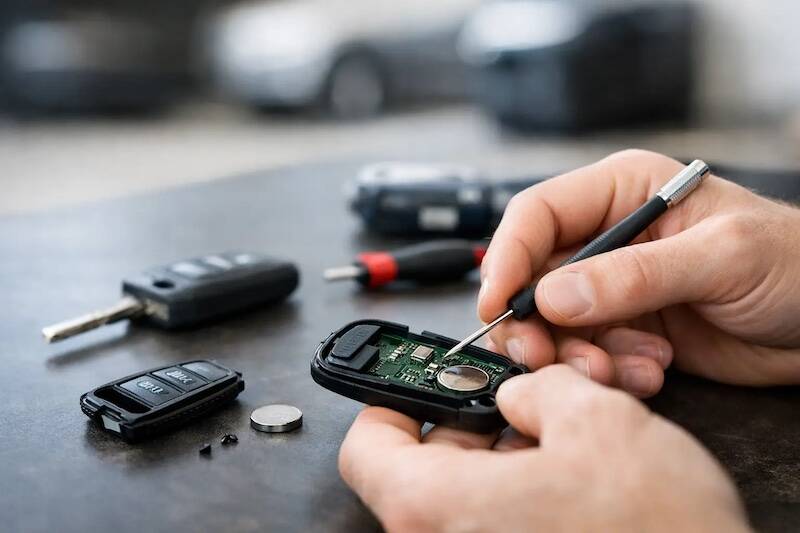
A key fob usually stops working at the worst possible moment - when you are late for work, parked outside the school, or standing in the rain with a car that will not open. That is why car key fob repair is not just about convenience. For many drivers, it is the difference between carrying on with the day and being completely stuck.
The good news is that not every faulty fob means you need a full replacement. In some cases, the problem is minor and quick to sort. In others, repair is possible but only worth doing if it saves time and money compared with replacing and programming a new key. The right option depends on what has actually failed.
When car key fob repair is possible
A car key fob is a small device, but there is a lot going on inside it. Depending on the vehicle, it may control remote locking, boot release, alarm functions and, in many cases, communicate with the immobiliser as well. Some faults affect only the remote buttons. Others stop the car from recognising the key altogether.
Repair is often possible when the issue is with the casing, the buttons, the battery contacts or damage to the circuit board that has not gone too far. If the fob has been dropped, sat on, or exposed to moisture, there may be visible wear without complete internal failure. In those cases, a proper inspection can show whether the fob can be brought back into working order.
If the transponder chip is damaged, missing, or no longer communicating with the vehicle, the answer may be different. Some keys can be rebuilt or reprogrammed. Others are more practical to replace entirely. This is where experience matters, because guessing can waste both time and money.
Common signs your key fob needs attention
Most drivers notice a problem gradually. The lock button works only after several presses. The range becomes shorter. One button stops responding while the others still work. Sometimes the car opens manually, but the remote functions fail without warning.
There are also cases where the key blade is fine but the plastic shell is cracked or the buttons have worn through. That may look minor, but it can expose the electronics to dirt and damp. Left long enough, a simple housing issue can turn into a more expensive fault.
Another common sign is when the car does not start even though the battery in the fob has been changed. People often assume the battery is the whole problem, but modern vehicle keys are not always that simple. A dead battery, broken solder joint, failed chip or programming issue can all produce similar symptoms.
The faults that are often mistaken for a dead battery
Battery failure is the first thing most people think of, and sometimes they are right. But a fresh battery does not fix everything. If the battery terminals inside the fob are bent, loose or corroded, the power may not be reaching the board properly. If a button switch has worn out, the fob may still have power but no way to send the signal.
Water damage is another frequent problem. Even a small amount of moisture can interfere with the circuit board. You might find the key works intermittently for a while, then stops altogether. In that situation, replacing the battery usually changes nothing.
Wear and tear also catches people out. Over time, repeated use can damage the soldering around the battery holder or push-button switches. This tends to happen on older keys and keys used heavily by commuters, delivery drivers and tradespeople. A fob that has lived in a pocket, van cup holder or tool bag for years takes a fair bit of punishment.
Repair or replacement - which makes more sense?
This is where it depends on the age of the vehicle, the type of key and the nature of the fault. If the casing is broken and the electronics still work, repair is usually the sensible option. Rehousing the internals into a new shell can restore normal use without the cost of a complete new key.
If the circuit board has a repairable fault, that may still be worthwhile. But if the key is badly damaged, the transponder has failed, or the car needs a freshly programmed replacement to be reliable, replacement can be the better long-term fix.
For many motorists, the real issue is not just cost. It is delay. If you rely on the car every day, waiting around for dealership appointments, ordering times and recovery arrangements can be more disruptive than the repair bill itself. A fast mobile service can often sort the problem at your location, which is why many drivers choose that route when time matters.
Why modern car key fob repair is not a DIY job
Changing a battery is one thing. Beyond that, most key fob faults need proper tools and a clear understanding of vehicle security systems. Opening the case the wrong way can snap clips, damage the circuit board or dislodge the transponder chip. That tiny chip is easy to lose and, on many vehicles, essential for starting the car.
There is also the programming side. Some keys can be resynchronised after battery changes or signal issues. Others need specialist diagnostic equipment. If the key and vehicle are no longer matched correctly, a home fix can quickly turn into a non-start situation.
That is why a professional assessment saves hassle. A good auto locksmith will tell you plainly whether the key can be repaired, whether replacement is the smarter option, and whether the issue is actually with the vehicle rather than the fob.
What a mobile specialist can do on site
The main advantage of using a mobile auto locksmith is that the problem can often be dealt with where the car is parked. That matters when the vehicle will not unlock, will not start, or cannot safely be left where it is.
A specialist can test the key, inspect the internal components, check signal output, confirm whether the transponder is present and working, and identify whether the issue is mechanical, electronic or programming-related. If repair is possible, it may be carried out there and then. If not, a replacement key can often be cut and programmed on site, which gets you moving again without towing the car anywhere.
That practical, no-fuss approach is exactly what stressed drivers need. It is also why mobile services have become the first call for many urgent key problems across Essex and beyond.
How to avoid key fob damage in the first place
No key lasts forever, but a bit of care does make a difference. Heavy keyrings put strain on both the blade and the casing. Dropping the fob repeatedly onto hard surfaces can loosen internal parts. Keeping it somewhere damp, hot or dirty, such as a work van dashboard or a coat pocket in bad weather, also shortens its life.
If the buttons are wearing, the shell is splitting or the fob only works occasionally, it is worth getting it checked before it fails completely. Small issues are usually easier to deal with early. Waiting until the only working key stops altogether gives you fewer options and usually more stress.
It is also sensible to have a spare if you only have one key left. A spare key is not just useful for emergencies. It takes the pressure off your main key and reduces the risk of being stranded by a sudden failure.
When to call for help
If your key fob has stopped unlocking the car, starts the car only intermittently, has visible damage, or still does nothing after a battery change, it is time to get it checked properly. The same applies if you have one key and it is already showing signs of wear.
A quick diagnosis can stop a small fault turning into a full lockout or lost-key situation. And if the key is beyond repair, you will know where you stand straight away rather than wasting time trying temporary fixes.
For drivers who need the problem solved fast, a mobile specialist such as Orme AutoKeys can often repair, replace or programme the right solution at the roadside, at home or at work. That means less disruption, less waiting, and a much quicker return to normal.
If your key is becoming unreliable, do not wait for the moment it fails completely. Getting ahead of the problem is often the simplest way to stay on the road.