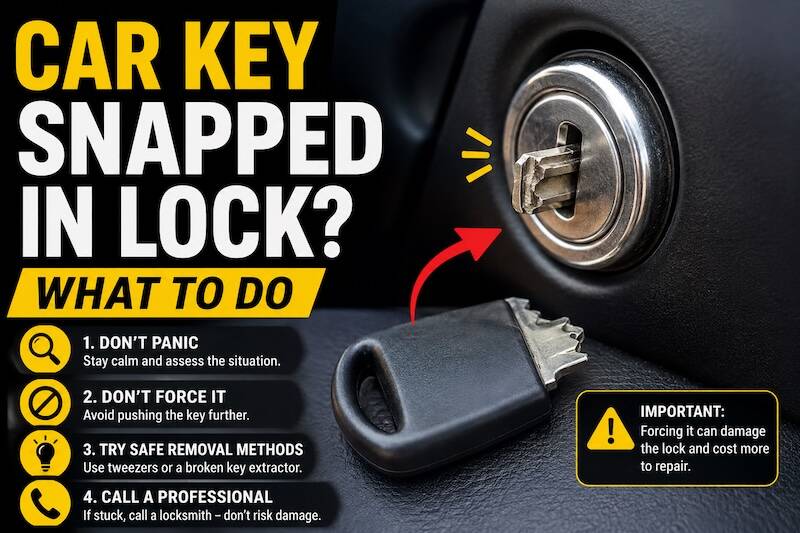
If you have a car key snapped in lock, the first few minutes matter more than most people realise. It is tempting to force the broken piece out with whatever you can find in the glovebox or kitchen drawer, but that is often what turns a fixable problem into a damaged lock, a jammed ignition or a bigger bill.
The good news is that a snapped car key does not always mean a new lock, a tow to a garage or a long wait at a main dealer. In many cases, the issue can be dealt with where the vehicle is parked, provided the right tools and approach are used.
What causes a car key to snap in a lock?
Keys usually break for a reason, not by pure bad luck. Most often, the metal has already weakened over time. If a key is bent slightly, worn down, cracked near the blade, or hard to turn, it is already warning you that something is not right.
Sometimes the problem is the lock rather than the key. Dirt inside the door lock, wear in the ignition barrel, or internal resistance can put extra strain on the blade every time you turn it. Cold weather can make things worse, especially if moisture has got into the lock and created stiffness. If you are using the same key several times a day for work, school runs or deliveries, repeated use speeds up wear.
Modern vehicle keys can also be more complex than they look. Many have a transponder chip, remote buttons and a cut blade housed together in one unit. If the blade snaps, the car may still need the programmed part of the key to start once access is regained. That is why this is not always just a case of removing the metal fragment and carrying on as normal.
Car key snapped in lock - what you should do first
Start by stopping completely. Do not keep twisting what is left of the key. Do not spray random oils into the lock. And do not push anything deeper into the keyway to see if it catches.
Take a look at where the key has broken. If part of the blade is visibly sticking out and the lock is not under tension, there may be a chance of careful removal. If the broken piece is flush inside the lock, or if the ignition is stuck in an awkward position, it is usually best to leave it alone and get proper help.
If you have a spare key at home, do not try to force it into the same lock while the broken piece is still inside. That can jam the lock mechanism and make extraction more difficult. The priority is to remove the fragment safely without damaging the lock itself.
If the car is in an unsafe place, focus on your surroundings first. If you are blocking traffic, parked on a busy road or stranded late at night, your safety comes before the lock. Move away from danger if you can and arrange assistance from there.
What not to do when a key breaks in a car lock
This is where many people make the problem worse. A pair of tweezers seems like a sensible idea, but ordinary tweezers are usually too thick to grip the broken blade properly. More often, they push it further in.
Superglue is another common mistake. Trying to glue the two key halves back together inside the lock can leave adhesive in the keyway, which creates a much bigger repair job. Paperclips, pins, screwdrivers and similar improvised tools can also scratch or distort the inside of the lock.
It also depends on where the key has snapped. A door lock may give slightly more access than an ignition barrel, but ignitions are especially sensitive. Force in the wrong place can affect steering lock components or damage the ignition housing. What starts as a broken key can quickly become a fault that leaves the car completely unusable.
Can you remove a snapped key yourself?
Sometimes, yes - but only in limited situations. If a small section of the key is clearly protruding and you can grip it without pushing it inward, a careful extraction may be possible. The key point is that it must come out easily. If there is resistance, stop.
The difficulty is that most snapped keys do not break neatly with enough metal exposed to grab. They tend to shear off inside the lock, often at the point where the blade has already been weakened. In those cases, specialist extraction tools are far more effective and far safer than household items.
Even if you do manage to remove the broken part, that is only half the job. You still need a working replacement key. On many vehicles, cutting a new blade is not enough. The replacement may need to be programmed to the car before it will start properly.
Why a mobile auto locksmith is usually the quickest fix
When a key snaps, most drivers assume the next step is a garage or main dealer. In reality, that often means more delay, more inconvenience and sometimes towing costs if the vehicle cannot be driven.
A mobile auto locksmith can usually deal with the problem on-site. That matters when you are at home, at work, in a supermarket car park or stranded away from your usual garage. Instead of arranging recovery and waiting days for the next step, the issue can often be handled there and then.
The job normally involves extracting the broken key piece, checking whether the lock has been damaged or was already failing, and cutting a replacement key to suit the vehicle. If programming is needed, that can often be done at the same visit. For motorists in Essex who need a fast, practical answer, that kind of service is often the most straightforward way to get back on the road fast.
Will the lock need replacing?
Not always. If the key snapped because the blade was weak but the lock is still in good condition, the lock may simply need the broken section removed. In that case, a new key can solve the problem without replacing any lock components.
If the lock was stiff, worn or internally damaged beforehand, replacement may be the better long-term fix. This is where experience matters. A proper assessment will tell you whether the lock is still serviceable or whether continuing to use it is likely to cause the same issue again.
It is worth being realistic here. The cheapest short-term option is not always the best one. If a lock is already failing, extracting the broken key and cutting another one may only delay the next breakdown. On the other hand, replacing parts unnecessarily adds cost you may not need. A good locksmith will tell you which side of that line your vehicle is on.
What if the broken key is in the ignition?
A snapped ignition key is usually more urgent than a broken door key. You may still be able to get into the car through a remote central locking function, but if the ignition barrel is blocked, the vehicle is not going anywhere.
This is also the situation where DIY attempts carry the most risk. Ignition barrels are tighter, more delicate and less forgiving than door locks. If the steering lock is engaged or the key has broken while turned, extraction becomes more complicated. Trying to force it free can damage the barrel or leave the ignition stuck.
In practical terms, if the key has snapped in the ignition, calling a specialist straight away is usually the quickest and least disruptive option.
How to reduce the chances of it happening again
A snapped key rarely comes without warning. If your key is bent, cracked, worn or feels loose in the head, replace it before it fails. If the lock feels rough, sticky or inconsistent, get it checked before repeated strain breaks the blade.
Using a damaged key because it still works most of the time is a false economy. The break never happens at a convenient moment. It happens when you are late, in the rain, on a job, on the school run or miles from home.
It also helps to keep a spare key in a safe place. Not in the same car, and not buried somewhere inaccessible. A proper spare can save a lot of stress if the main key fails unexpectedly.
When your car key snaps in the lock, the best move is usually the simplest one - stop, avoid making it worse, and get the right help so the problem is sorted properly where the car is.